


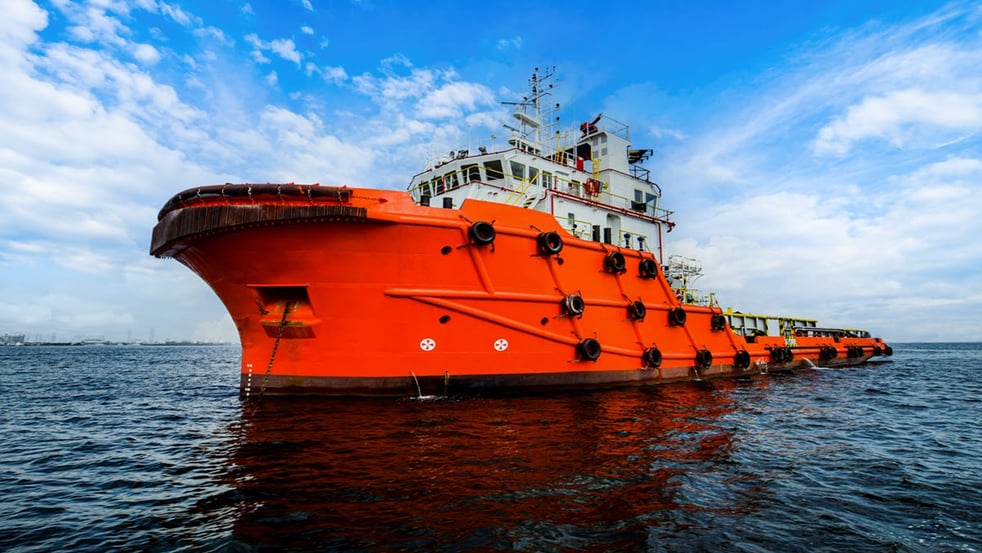
Since 1 January 2024, the EU Emission Trading System (ETS) has applied to shipborne carbon dioxide (CO₂) emissions of cargo or passenger ships of 5,000 gross tonnage (GT) or above, calling at a port located in the European Economic Area (EEA)[1] for commercial purposes. The scope of the EU ETS will be extended from 2027.
Introduction
From 1 January 2027, the application of the EU ETS Directive (EU ETS)[2] will extend to include offshore vessels of 5,000 GT or above.
Already, since 1 January 2026, the maritime scope of EU ETS has not only included CO₂ emissions alone, but also methane (CH₄) and nitrous oxide (N₂O) emissions[3].
So, from 2027 onwards offshore shipping companies will have to surrender EU Allowances (EUAs) in respect of CO₂, methane (CH₄) and nitrous oxide (N₂O) emissions for all their ships that call at a port within the EEA commercially.
If an offshore vessel calls at an EEA port for non-commercial reasons, e.g., obtaining supplies, a ship being in need of assistance or in distress, taking shelter from adverse weather, or it being rendered necessary by search and rescue activities, etc., then such port call is not deemed to be a 'port of call' for the purposes of the EU ETS, provided that no commercial operation takes place during that same call [4].
Shipping company
In the context of EU ETS, 'shipping company' means the shipowner or the manager or the bareboat charterer that has assumed the responsibility for the operation of the ship from the shipowner and that, on assuming such responsibility, has agreed to take over all the duties and responsibilities imposed by the International Safety Management (ISM) Code[5].
Compliance
The default position is that the party responsible for EU ETS compliance is the registered shipowner. However, the registered shipowner can delegate to an ISM company to fulfil these responsibilities in its place[6]. This mandate requires that an ISM company which has assumed responsibility for the EU ETS obligations must inform its administering authority of the mandate and provide information on ships under its responsibility.
Obligations of the shipping company
The shipping company has the duty to ensure that, by 30 September each year, it surrenders a number of EUAs that is equal to its total emissions during the preceding calendar year[7], as verified in accordance with Article 3ge EU ETS. For the 2027 compliance period, which equals the 2027 calendar year, each shipping company must obtain enough EUAs to surrender them to the competent administering authority by 30 September 2028 at the latest.
EU emission allowances (EUAs)
Each ton of CO₂ equivalent emissions must be compensated with one EUA[8]. The EU ETS makes a distinction as to the percentage of emissions released between extra-EEA and intra-EEA voyages[9].
Extra-EEA voyages either depart from a port of call under the jurisdiction of a Member State and arrive at a port of call outside the jurisdiction of a Member State, or vice versa; whilst Intra-EEA voyages originate from a port of call under the jurisdiction of a Member State and end at a port of call under the jurisdiction of a Member State.
For extra-EEA voyages, only 50% of the CO₂ equivalent emissions must be compensated by EUAs, whilst for intra-EEA voyages 100% of the CO₂ equivalent emissions must be matched by an equivalent number of EUAs.
EUAs can be bought bilaterally or through various derivatives provided by financial institutions or trading brokers. Any EUAs issued on or after 2013 do not expire, so they can be traded, sold on, or banked for future use.
Shipping companies can use their MOHA to trade EUAs; charterers, however, cannot open a MOHA, but instead they can open a trading account to purchase EUAs and use that trading account to transfer EUAs to shipowners as per the obligations of the agreed charter for each vessel. So, whilst charterers can buy and trade EUAs as well as transfer them they cannot surrender them for and on behalf of the shipping companies or ship owners to the authorities.
Maritime Operator Holding Account ("MOHA")
EUAs can only be surrendered to the competent EEA administering authority from a Maritime Operator Holding Account ("MOHA") which must be opened in the same EEA country in which their administering authority[10] is registered. For shipping companies with their registered place of business in an EEA country, the MOHA must be opened in the same country.
When it comes to shipping companies outside the EEA, they must be assigned to a competent EEA administering authority. The EU came out with a list[11] for some of the shipping companies, but if a shipping company does not find itself on the list, the registered shipowner can either contract with an ISM company which is already assigned a competent authority to take on the EU ETS responsibilities on behalf of the registered owner, or alternatively the shipping company will be assigned a competent administering authority based on the first voyage within the scope of that EU ETS Directive and which is a voyage between ports under the jurisdiction of two Member States[12].
Conclusion
Skuld encourages its offshore members and assureds to familiarise themselves with the application of the EU ETS and particularly of how to cater for their needs in their contracts.
[1] The EEA includes all EU member states plus Iceland, Liechtenstein, and Norway.
[2] EU ETS is the Directive 2003/87/EC in its current consolidated format; to be found here: https://eur-lex.europa.eu/eli/dir/2003/87/2024-03-01/eng
[3] Art. 3 (b), 3 (c), 3 (j) and Annex II EU ETS
[4] Art. 3(z) EU ETS
[5] Art. 3 (w) EU ETS
[6] http://data.europa.eu/eli/reg_impl/2023/2599/oj
[7] Art. 12 (3)(c) EU ETS
[8] Article 3(a) of Directive 2003/87/EC
[9] Article 3ga(1) of Directive 2003/87/EC (EU ETS Directive)
[10] https://climate.ec.europa.eu/document/download/765ad567-084f-4ccf-b14a-bade4b6a99f7_en?
[11] http://data.europa.eu/eli/dec_impl/2024/411/oj
[12] http://data.europa.eu/eli/reg_impl/2023/2599/oj