


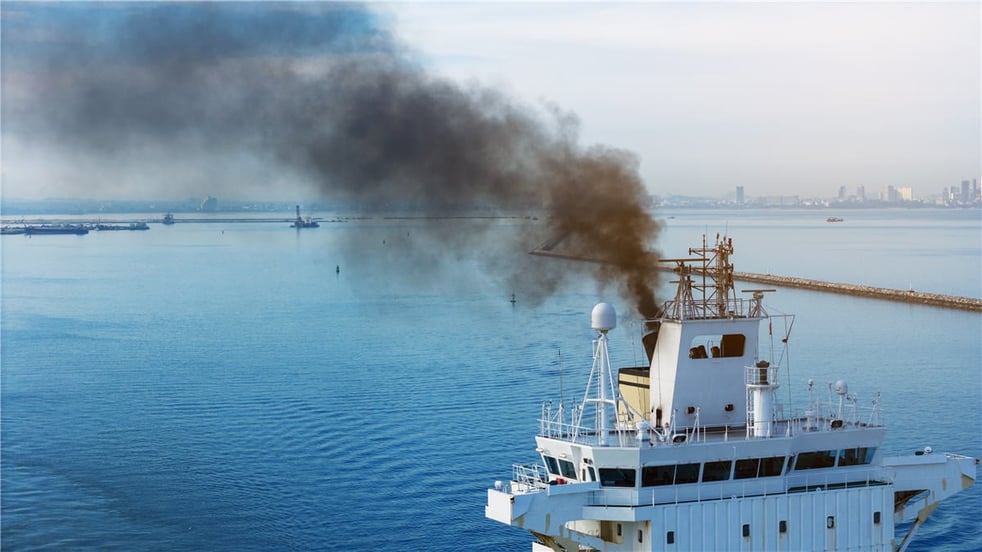
Following the EU regulations aimed at reducing greenhouse gas (GHG) emissions in shipping, the UK Emission Trading Scheme (UK ETS) for Maritime became effective on 1 July 2026 and applies to domestic maritime activities. The expansion of the UK ETS into maritime is part of the United Kingdom's (UK) Government's Net Zero Strategy[1].
Application
From 1 July 2026, the UK ETS applies to ships of a gross tonnage (GT) of 5000 or more[2], with plans to review this by 2028.[3] From that date on, maritime activities are regulated under the UK ETS.
From 1 January 2027, the application of the UK ETS will extend to offshore ships of 5000 gross tonnage (GT) and above, which include offshore construction vessels, offshore supply ships and offshore support vessels[4].
These ships must report their air emissions. The emissions of ships falling under the scope of the UK ETS include greenhouse gas emissions from combustion and slippage[5] of carbon dioxide (CO₂), methane (CH₄) and nitrous oxide (N₂O), calculated on a tank‑to‑wake basis.
Excluded ships
Ships of 5,000 GT or above, exempted from the reporting obligation under the UK ETS, are, for example:
- Ships in the armed services of the United Kingdom or another country (including a naval auxiliary ship);
- Ships, the principal use of which is for law enforcement (e.g., for the purposes of border enforcement or for customs purposes);
- Ships mainly used for government surveillance and protection of the marine environment;
- Ships predominantly used for assisting marine navigation or safe passage;
- Ships primarily used for fish-catching and fish processing;
- Ships principally used to carry out, or facilitate the carrying out of, publicly funded research;
- Ships, the preeminent use of which is to undertake coastguard or search and rescue activities;
- Ships which are mainly used for responding to medical emergencies;
- Ships exclusively propelled by non-mechanical means;
- Wooden ships of a primitive build;
- Any ships that operate a Scottish ferry service[6];
- Up to and including 31 December 2026, any offshore ships.
Geographical scope
Ship operators are required to monitor and report emissions occurring in UK ports and on domestic UK voyages. As a result, emissions from ports of call on international routes are also captured under the UK ETS.
Port emissions
The monitoring and reporting of greenhouse gas (GHG) emissions of ships includes those released during any maritime in-port activities in a port or at a berth within the territory of the UK[7]. With the explicit mentioning of the UK ETS extending territorially only to the UK, it is implied that the territorial scope of the UK ETS does not extend to UK Overseas Territories such as Gibraltar.
Operators must submit reports containing emissions data for activities covered by the UK ETS, including emissions associated with Northern Ireland where relevant, and must also report their total combined (aggregated) GHG emissions from all UK ETS maritime activities. The rules on what data must be monitored and what information must be reported are set out in Schedule 2A of the UK ETS Order 2020, as inserted by SI 2026/392[8].
Domestic voyages between ports within Great Britain (England, Scotland and Wales)
For maritime activities within Great Britain, the following count of GHG emissions applies:
- 100% of emissions released during voyages between UK ports (domestic voyages); and
- 100% of emissions generated while vessels are in UK ports, including at berth and anchorage[9].
Domestic voyages between ports of Great Britain and Northern Ireland
- 50% of emissions released during voyages that originate or end in a Great Britain port and that end or originate in a port in Northern Ireland[10]; and
- 100% of emissions generated, including at berth and anchorage while vessels are in UK ports, this includes any ports within the territory of Great Britain and Northern Ireland.
International voyage
The inclusion of emissions released during international voyages that originate or end at UK ports is not yet part of the scope of the UK ETS. In the future, the UK Authority may include GHG emissions from international voyages.[11]
Currently, the UK ETS is a UK-based (territorial) instrument, not a route-based one like the EU ETS.
Port of call
A "port of call" under the UK ETS means any port at which a ship arrives or is present at and at which —
- Passengers or crew embark, or disembark, that ship; or
- Cargo is loaded onto, or unloaded from, that ship[12].
A "port" includes an offshore installation that has an assigned United Nations Code for Trade and Transport Locations (UN/LOCODE) at the date this Order is made[13].
The following instances do not qualify as a "port of call": If a vessel arrives or is present at a port exclusively for the purpose of —
- Refuelling the ship;
- Obtaining supplies in connection with the operation of the ship;
- Relieving the ship’s crew, other than relieving of crew of an offshore ship;
- Going into dry dock;
- Obtaining repairs to the ship or its equipment;
- Sheltering from adverse weather conditions;
- Obtaining assistance where the ship is in distress; or
Furthermore, a port call does not qualify as a "port of call" for the purposes of the UK ETS, if the arrival or presence at the port is rendered necessary as a result of —
- A medical emergency;
- Search and rescue activities;
- The provision of assistance to a ship in distress;
Included maritime activities
A maritime activity[14] which falls under the UK ETS is any movement of a ship that —
- Commences at the last berth[15] at a port of call within the UK’s jurisdiction;
- Ends at the first berth at that port of call or another port of call within the UK’s jurisdiction;
- Does not arrive at a port of call outside the UK’s jurisdiction; and
- Is not an excluded activity.
Excluded maritime activities
Certain maritime activities will be exempted from the reporting requirement under the UK ETS[16]. An activity is excluded if performed for the exclusive purpose of —
- Official missions of the Government,
- Military activities,
- Search and rescue missions,
- Firefighting,
- Providing humanitarian aid or assistance, or
- Carrying out a government function which do not otherwise fall within the activities listed above.
Reporting period
The first scheme year will run from 1 July 2026 to 31 December 2026, with subsequent years from 1 January to 31 December[17]. So, aside from 2026, when only half of the year is subject to reporting (from 1 July 2026 until the year-end), the standard reporting period or scheme period under the UK ETS will be the full calendar year.
Compliance
The party which carries the duty to report or compliance burden towards the UK authorities is the Maritime Operator[18].
A Maritime Operator in relation to a scheme period is, by default, the registered owner of a ship. If, however, the registered owner does not perform the duties of an ISM company, then the registered owner can delegate the UK ETS responsibilities of the Maritime Operator to the ISM company of the vessel, provided that the ISM company has entered into a legally binding agreement in writing to assume responsibility for compliance with the obligations of the UK ETS instead, with the registered owner. In addition, the same agreement must be reported to the UK ETS regulator as well as any changes thereto[19]; otherwise, the transfer of UK ETS responsibilities from the registered owner to the ISM company will not be valid.
Where the party that has performed a maritime activity is not known, including where the regulator could not be satisfied that the ISM Company had duly assumed responsibility for UK ETS compliance in respect of the relevant ship, the Registered Owner will be deemed to have performed that maritime activity, and so to be the Maritime Operator in respect of that ship[20].
This method is consistent with that adopted by the EU ETS. The approach should also mitigate additional administrative burden for most operators who will be participating in both schemes, many of whom will also have established contractual responsibilities in relation to emissions trading. It should provide flexibility for the relevant stakeholders to determine, for each ship, which entity is best placed to comply with the UK ETS obligations. For example, it will enable the entity with the existing responsibility for compliance with the EU ETS and EU MRV, and/or the IMO Fuel Oil Consumption Data Collection System (DCS), to assume also the responsibility for compliance with the obligations of the UK ETS.[21]
Regulatory regime
Under the UK ETS maritime regime, Maritime Operators report to their assigned UK ETS regulator[22].
In the UK, there are four UK ETS regulators whose contact details can also be found in the UK ETS guidance document[23]. Maritime Operators are assigned to one of these UK ETS regulators based on where the Maritime Operator's registered office or place of residence is located[24].
The four UK ETS regulators are:
- The Environment Agency (EA) – for operators based in England, and for operators registered outside the UK;
- The Scottish Environment Protection Agency (SEPA) – for operators located in Scotland;
- The Natural Resources Wales (NRW) – for operators based in Wales; and
- Northern Ireland Environment Agency (NIEA) – for operators registered in Northern Ireland.
These UK ETS regulators are the functional equivalent in the UK to the EU ETS concept of an "EU ETS administering authority" if it comes to the performance of many of the roles that an EU ETS administering authority would fulfill, including approving monitoring plans, receiving emissions reports, overseeing compliance, and taking enforcement action.
One additional role of a UK ETS regulator, compared to the role of an EU ETS administering authority, is that the Environment Agency also acts as the UK ETS Registry Administrator for the UK ETS Registry on behalf of all regulators.
Scope of reports to the UK ETS regulator
The Maritime Operator must submit, amongst other things:
- An Emissions Monitoring Plan (EMP) for approval by the regulator;
- An annual verified Annual Emissions Report (AER); and
- Any required improvement reports or notifications under the UK ETS rules.
Maritime Operators must apply for their EMP within the "Manage your UK Emissions Trading Scheme reporting service (METS)" platform, if not already done, within 42 days of commencing the performance of a maritime activity. Guidance can be found on UK Government websites[25]. The METS account, which must be set up, can be accessed in the METS ETS Gateway[26] using the login details provided by the regulator.
Compensation for GHG emissions
One UK emission allowance (UKA) must be surrendered for each tonne of CO₂e (carbon dioxide equivalent) and registered in the "UK ETS Registry" by the Maritime Operators. The Maritime Operators must open a so-called Maritime Operator Holding Account (MOHA) for keeping UKAs as same need to be transferred from that account to the UK ETS regulator when the UKAs are due; the first deadline for surrendering the EUAs for the scheme periods 2026 and 2027 is 30 April 2028. Information about how to set up a MOHA in the UK can be found on the webpage of the UK Emissions Trading Registry[27].
UKAs may be purchased via auctions or on the secondary market throughout the year, meaning that Maritime Operators can choose to purchase such UKAs at any point in the year in preparation for surrender.[28]
Upcoming timelines
- 31 March 2027: Reporting deadline for the 2026 scheme period
- 31 March 2028: Reporting deadline for the 2027 scheme period
- 30 April 2028: First surrender deadline for the 2026 and 2027 scheme periods
Linking the EU and UK emissions trading systems
The European Commission released a final recommendation on 16 July 2025 for a Council Decision authorising the opening of negotiations between the European Union (EU) and the UK on a common sanitary and phytosanitary area between the EU and the UK in respect of Great Britain and linking the UK and the EU’s greenhouse emissions trading systems.[29]
The Annex to the above-mentioned Council Decision[30] sets out in more detail how the EU ETS and the UK ETS should apply.
The intended agreement linking the UK and the EU's greenhouse gas emissions trading systems should cover the territories defined by the Treaties for the EU, and Great Britain for the UK, with Northern Ireland included, except in relation to wholesale electricity markets, which remain governed by the Windsor Framework. The UK must also match the EU's territorial scope for maritime transport emissions trading.
Some of the goals of an agreement between the EU and the UK to link their respective emission trading systems are, as per the Council Decision and its Annex mentioned above, the following:
- The agreement should address all elements related to the connection of emission trading systems, including those under the EU ETS Directive[31], which establishes a greenhouse gas emission allowance trading system within the Union and its related legislation.
- The agreement should clearly define its scope, covering sectors such as electricity generation and both domestic and international maritime transport. It must ensure that the UK aligns dynamically with relevant EU rules to prevent carbon leakage and competitive distortions. A procedure should also be included to expand the list of covered sectors as needed.
- The agreement should additionally guarantee dynamic alignment of the UK with the EU's financial regulatory and supervisory framework governing the trade of EU ETS allowances and associated derivatives.
- The agreement must ensure the UK's cap and reduction pathway matches or exceeds that of the EU. The agreement should not limit the ability of the EU or the UK to pursue higher environmental standards in accordance with their international obligations.
- The agreement must contain provisions requiring each party to acknowledge emission allowances issued under the other party's emissions trading system.
- The agreement should enable goods from the EU and the UK to receive mutual exemptions from their respective Carbon Border Adjustment Mechanisms, provided they comply with the respective legislation.
Guidance Documents and other resources
- UK Government Guidance document - UK Emissions Trading Scheme for maritime: how to comply - https://www.gov.uk/guidance/uk-emissions-trading-scheme-for-maritime-how-to-comply
- Manage your UK Emissions Trading Scheme reporting - https://manage-emissions-reporting.service.gov.uk/landing
- UK Emissions Trading Scheme (UK ETS): technical guidance and tools - https://www.gov.uk/government/collections/uk-emissions-trading-scheme-uk-ets-technical-guidance-and-tools
- Helpful UK ETS Maritime guidance videos released by the UK Government - https://www.youtube.com/playlist?list=PLeBa_fvBDFF4IBiLvHwashHLSJJOmrZqe
- The Greenhouse Gas Emissions Trading Scheme (Amendment) (Extension to Maritime Activities) Order 2026 - https://www.legislation.gov.uk/uksi/2026/392/made/data.pdf
If members have any questions about the UK ETS, we ask them to please reach out to their designated Skuld contact.
[1] https://www.gov.uk/government/consultations/uk-ets-scope-expansion-maritime-sector/uk-emissions-trading-scheme-scope-expansion-maritime-html
[2] "The Greenhouse Gas Emissions Trading Scheme (Amendment) (Extension to Maritime Activities) Order 2026" Schedule 2A, Part 2, Paragraph 5 of SI 2026 No. 392
[3] https://www.gov.uk/government/consultations/uk-ets-scope-expansion-maritime-sector/outcome/uk-ets-scope-expansion-domestic-maritime-main-authority-response-accessible-webpage
[4] Schedule 2A, Part I, Paragraph 2 (p), (q), (r) of SI 2026 No. 392
[5] The inclusion of slippage arises implicitly through methane emission factors as per the Monitoring and Reporting Regulation (MRR) 2018.
[6] "Scottish ferry service" as defined in sub-paragraph (3) of paragraph 2, Part 2 of Schedule 2A of the Statutory Instrument (SI) 2026 No. 392
[7] Schedule 2A of the Statutory Instrument (SI) 2026 No. 392, Article 1(2) linked in footnote 5 above.
[8] https://www.legislation.gov.uk/ukdsi/2026/9780348278279/schedules
[9] Schedule 2A, Part 2 and Part 4 of SI 2026 No. 392
[10] Schedule 2A, Part 2, Paragraph 15 of SI 2026 No. 392
[11] https://www.gov.uk/government/consultations/uk-ets-scope-expansion-emissions-from-international-maritime-voyages/uk-ets-scope-expansion-emissions-from-international-maritime-voyages-consultation-accessible-webpage
[12] Schedule 2A, Part 2, Paragraph 6 of SI 2026 No. 392
[13] A list of UN/LOCODE Codes at the time the Order is made can be accessed at https://www.gov.uk/government/publications/offshore-installations-with-a-un-code-for-trade-and-transport-locations-unlocode. A copy may be inspected at the Department for Energy Security and Net Zero, 3-8 Whitehall, London, SW1A 2JP.
[14] Schedule 2A, Part 2, Paragraph 7 of SI 2026 No. 392
[15] "At berth" means, in relation to a ship, being securely moored or anchored in a port while that ship is loading, unloading or hotelling, including the time spent when not engaged in cargo operations
[16] Schedule 2A, Part 2, Paragraph 7 of SI 2026 No. 392
[17] https://assets.publishing.service.gov.uk/media/687de724a5561a5a7e726bd9/uk-ets-maritime-interim-authority-response.pdf
[18] Schedule 2A, Part 2, Paragraph 3 of SI 2026 No. 392
[19] Schedule 2A, Part 2, Paragraph 4 (1) of SI 2026 No. 392
[20] Schedule 2A, Part 2, Paragraph 3 (3) of SI 2026 No. 392
[21] Page 17 of https://assets.publishing.service.gov.uk/media/687de724a5561a5a7e726bd9/uk-ets-maritime-interim-authority-response.pdf
[22] https://www.gov.uk/guidance/uk-emissions-trading-scheme-for-maritime-how-to-comply
[23] https://www.gov.uk/guidance/uk-emissions-trading-scheme-for-maritime-how-to-comply
[24] https://www.gov.uk/guidance/uk-emissions-trading-scheme-for-maritime-how-to-comply
[25] https://www.gov.uk/guidance/uk-emissions-trading-scheme-for-maritime-how-to-comply#apply-for-an-emissions-monitoring-plan
[26] https://manage-emissions-reporting.service.gov.uk/landing
[27] https://view-emissions-trading-registry.service.gov.uk/
[28] Page 17 of https://assets.publishing.service.gov.uk/media/687de724a5561a5a7e726bd9/uk-ets-maritime-interim-authority-response.pdf
[29] https://eur-lex.europa.eu/legal-content/EN/TXT/?uri=CELEX%3A52025PC0408 and https://ec.europa.eu/transparency/documents-register/detail?ref=COM(2025)408&lang=en
[30] https://ec.europa.eu/transparency/documents-register/detail?ref=COM(2025)408&lang=en