


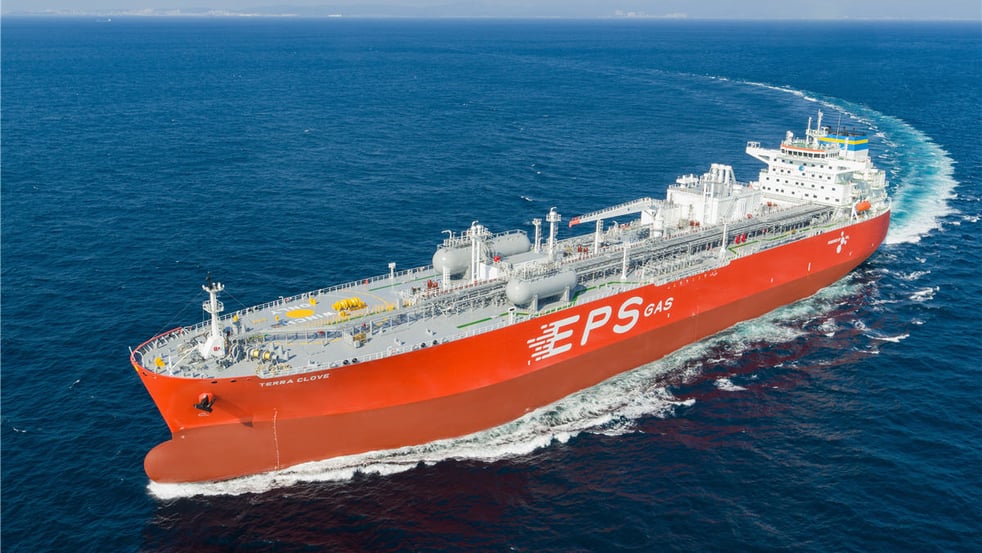
With the delivery of Terra Clove, Eastern Pacific Shipping (EPS) has reached a major milestone in its alternative-fuel journey. The 93,000 m³ vessel is the world’s first ammonia-dual-fuel very large ammonia carrier (VLAC) and provides EPS with a platform to build practical operational experience with ammonia as a marine fuel.
In that regard, we spoke with Oystein Kalleklev, Managing Director, Commercial – Gas, at EPS, to hear his perspectives on the vessel's delivery, the opportunities and challenges of operating on ammonia, and what lies ahead, with additional technical insights from Mirtcho Spassov, Manager Decarbonisation, at EPS.
Green ammonia availability
Terra Clove is designed to operate on both ammonia and conventional marine fuel. How does EPS see the availability of green ammonia developing in the short term, and what will this mean for the vessel’s initial operations?
Scaling the use of green ammonia by ammonia dual-fuel vessels requires reliable supply, suitable bunkering infrastructure and commercially viable pricing. As a gas carrier, Terra Clove is in a privileged position, as she can use ammonia cargo as fuel, reducing her reliance on dedicated ammonia bunkering infrastructure when carrying ammonia.
Terra Clove has already bunkered 800 tonnes of green ammonia at Ulsan Port, marking an important milestone in demonstrating its use as a marine fuel. The extent to which the vessel operates on green (or blue) ammonia in the future will be determined by the charterer, taking into account their trading requirements (i.e. whether the vessel transports LPG or ammonia), regulatory regime (i.e. if they are trading on EU-regulated trades, for example where they can secure EU ETS and FuelEU benefits) and cargo pricing.
Our focus is on building practical operating experience to support the wider adoption of ammonia as a marine fuel.
Safety, competence and crew training
Ammonia introduces new operational and safety considerations, both as cargo and as fuel. How has EPS built on its experience carrying ammonia to prepare its organisation and crew to safely operate Terra Clove, and what has the training process looked like?
Safety has been a key priority throughout Terra Clove's development. EPS has worked closely with HD Hyundai Heavy Industries, Everllence, ABS and MPA on technical assurance, regulatory engagement and specialised crew training.
EPS has prepared its organisation and crew for Terra Clove by treating ammonia readiness as a capability that goes beyond regulatory certification. A dedicated dual-fuel team of specialists with LNG, LPG, ammonia-cargo and dual-fuel experience has supported vessel development, safety studies, procedures and training, while relevant shoreside functions also receive role-specific familiarisation.
Crew preparation builds on regulatory requirements and adds ammonia-specific and vessel-specific competencies, with training roughly split between theory and practical exercises. This is reinforced through OEM and yard training, commissioning, sea trials, equipment walk-downs and drills on the actual vessel, with competency verified through practical demonstrations and task assessments rather than course attendance alone.
Ammonia as cargo and fuel
Terra Clove is both an ammonia carrier and capable of using ammonia as fuel. Does this create any particular advantages or learning opportunities compared with introducing ammonia fuel on other vessel types?
Terra Clove's ability to use ammonia cargo as a fuel enables the vessel to be among the first in the world to consume ammonia, without having to wait for the emergence of dedicated ammonia bunkering hubs/vessels. There are also additional advantages related to safety and crew training, as we have been able to build on the already strong experience of our gas carrier crews in handling ammonia. Today, EPS operates several medium-size gas carriers (MGC) in the ammonia trade, and we also have experience operating large gas carriers (LGC) in this trade, so utilising VLAC for large ammonia cargoes is the natural next step.
Regulation and the IMO Net-Zero Framework
Do you expect Terra Clove to trade under any regulatory or emissions-related schemes in which its dual-fuel ammonia capability could be particularly relevant? And looking ahead to the upcoming MEPC discussions on the IMO Net-Zero Framework, how could the regulatory direction affect the vessel’s first years of operation?
Regulatory certainty, a reliable supply of competitively priced fuel and customer demand will be key to the wider adoption of ammonia as a marine fuel. The EU Emissions Trading System (EU ETS) can help strengthen the economic case for lower-emission fuels on routes within its scope. A clear and consistent global regulatory framework would give the industry greater confidence to invest and help narrow the cost gap with conventional fuels.
For Terra Clove, the charterer will determine the cargo, trading routes and fuel procurement, taking into account commercial and regulatory considerations.
Impact on EPS's newbuilding programme
How could the operational experience and lessons from Terra Clove influence EPS’s wider newbuilding programme and its approach to alternative-fuel vessels going forward?
Terra Clove is EPS's first ammonia dual-fuel vessel and the first of two 93,000 m³ VLACs being built by HD Hyundai Heavy Industries.
We see ammonia as having the potential to play a long-term role in our dual-fuel vessel portfolio, alongside vessels operating on other alternative fuels like LNG and bio-LNG and energy efficiency technologies. Terra Clove represents an important opportunity for EPS to be among the pioneers in developing the knowledge and capabilities needed to operate dual-fuel ammonia vessels, and we intend to leverage these learnings to guide future deployments across other vessel types.
Sharing lessons with the industry
Alongside the delivery of Terra Clove, EPS has entered a strategic partnership with the Mærsk Mc-Kinney Møller Center for Zero Carbon Shipping (Center). The collaboration will focus on areas including alternative fuels, dual-fuel vessels, energy efficiency, ammonia safety and emissions, while sharing operational insights and practical learnings with the wider maritime industry.
How do you expect collaboration with the Center to support the safe and practical deployment of ammonia and other alternative fuels, and how will EPS share the lessons from Terra Clove with the wider maritime industry?
Our partnership with the Mærsk Mc-Kinney Møller Center for Zero Carbon Shipping brings together EPS's practical operational experience and the Center's research and technical expertise.
Terra Clove represents an important opportunity for EPS to build practical experience with ammonia propulsion and contribute to the wider industry's understanding of its safe operation. Through joint research and industry engagement, we will collaborate on key areas including alternative fuels, dual-fuel vessels, ammonia safety and emissions.
By combining operational insights with technical research and sharing lessons learned, we aim to strengthen safety, support crew readiness and contribute to the development of safer and more practical solutions for the adoption of ammonia as a marine fuel.
Supporting members through change
As alternative-fuel and dual-fuel vessels continue to develop, Skuld remains focused on understanding the associated risks and supporting members through the transition. Kristian Løberg, Chief Underwriting Officer at Skuld, comments:
"As our members invest in new fuels and technologies, our role is to understand what these changes mean for their operations and risk exposure. Terra Clove offers a valuable opportunity to learn from the practical application of ammonia as a marine fuel. Close dialogue with members such as EPS helps us deepen our understanding and provide relevant advice and support."