


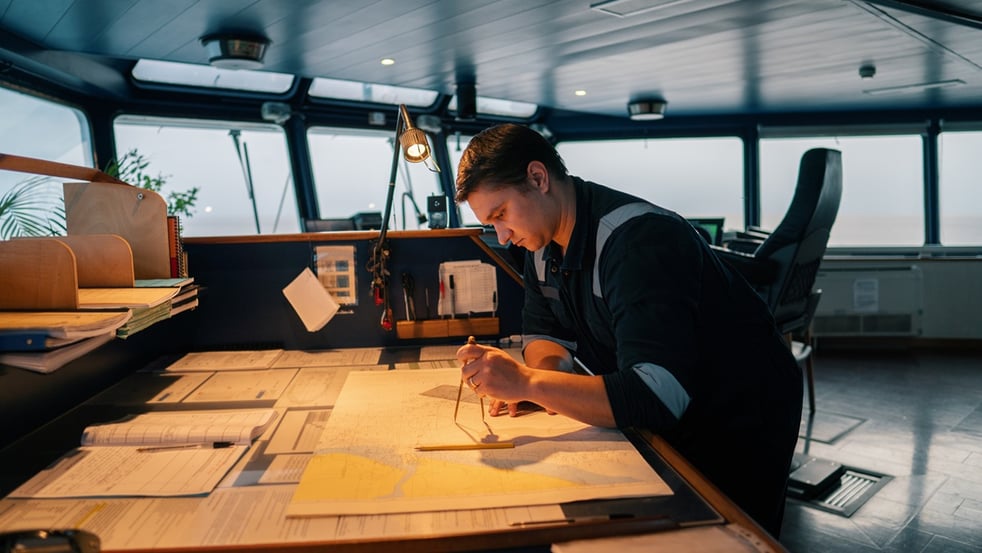
The cause of recent grounding cases
Passage planning is essential for safe navigation. Recent grounding incidents recorded by Skuld indicate significant weaknesses not only in the preparation phase but also in execution. While grounding incidents typically occur in restricted waters such as ports, channels, and rivers, an increasing number have originated from open-water navigation, where risks are generally considered lower. Investigations revealed that vessels deviated from planned routes despite having satisfactory passage plans. Notably, these incidents often occur during watches by the master or chief officer. In contrast, no incidents occurred under the second officer's watch, who is typically responsible for preparing the passage plan. This trend highlights a systemic failure in the implementation and adherence to passage plans.
The grounding of MV "CMA CGM LIBRA" in 2011 serves as a pertinent example. Courts later determined that the vessel was unseaworthy at the start of the voyage due to failures in both appraisal (using outdated charts and uncorrected shoals) and execution (the master’s decision to deviate from the planned fairway). This case illustrates that even a technically sound passage plan provides weak protection if its execution on the bridge is inconsistent or poorly managed.
Passage plan briefing: a key to execution
IMO Resolution A.893(21) identifies execution as one of the four essential components of passage planning, with effective bridge team organisation at its core. Execution involves more than merely following a planned route; it requires coordinated teamwork, clear task allocation, and a shared understanding of the navigation strategy. The most critical element of this organisational process is the passage plan briefing.
As the planner and approver of the plan, the second officer and the master must conduct a comprehensive briefing of the entire bridge team, including the chief officer and third officer. This briefing should emphasise key aspects of the passage, such as no-go areas, high-risk areas, charted hazards, distance off danger, under-keel clearance (UKC), CATZOC, cross track limit (XTL), abort points, and contingency actions. A thorough understanding of the plan among all officers ensures consistent situational awareness and reinforces accountability. The master, as the final approver of the plan, must ensure that all officers are familiar with it and prepared to execute it correctly, particularly during critical navigational phases.
A well-briefed passage plan becomes a practical and actionable tool. Without such a briefing, even a well-planned passage risks becoming mere "paperwork," disconnected from effective navigation.
From planning to practice: strong execution, safer voyages
A good passage plan needs to be technically sound, reasonable, and practical; however, it only works effectively when properly executed and supervised. Even the best passage plan can fail if there are problems in execution, supervision, or communication. A passage plan is effective only when fully implemented and monitored throughout the passage, ensuring safety at every stage.
Grounding incidents often occur during critical navigation periods, such as arriving at or leaving ports, navigating in pilotage areas, and in restricted or shallow waters, and when there is insufficient distance from the danger. These situations highlight the need for strong bridge team management and for strict adherence to the planned route.
The case of MV “CMA CGM LIBRA” shows that execution failures can have consequences as serious as planning problems. In past grounding incidents, even when the passage plan itself was good, failures in execution and supervision were seen as problems in bridge team management, leading to an ISM failure. These issues ultimately led the court to find the vessel unseaworthy. This highlights an important point: a plan that isn’t followed can be just as bad as a poorly made plan.
In summary, while the appraisal and planning steps are essential, it is the execution phase that determines whether a vessel can navigate safely. Effective execution turns a passage plan from a simple document into a real safety measure. A well-organised bridge team, backed by thorough briefings and consistent following of the plan, remains the best way to prevent navigational accidents.